Logistic Regression
Logistic regression models a binary output as a probability generated by a linear function of the inputs . Given a dataset , where and , we assume the model
where is the sigmoid (logistic) function that squashes real values into .One way to estimate the optimal parameters is by maximizing the likelihood of the observed binary (Bernoulli) labels under this probabilistic model. For each observation, it follows that
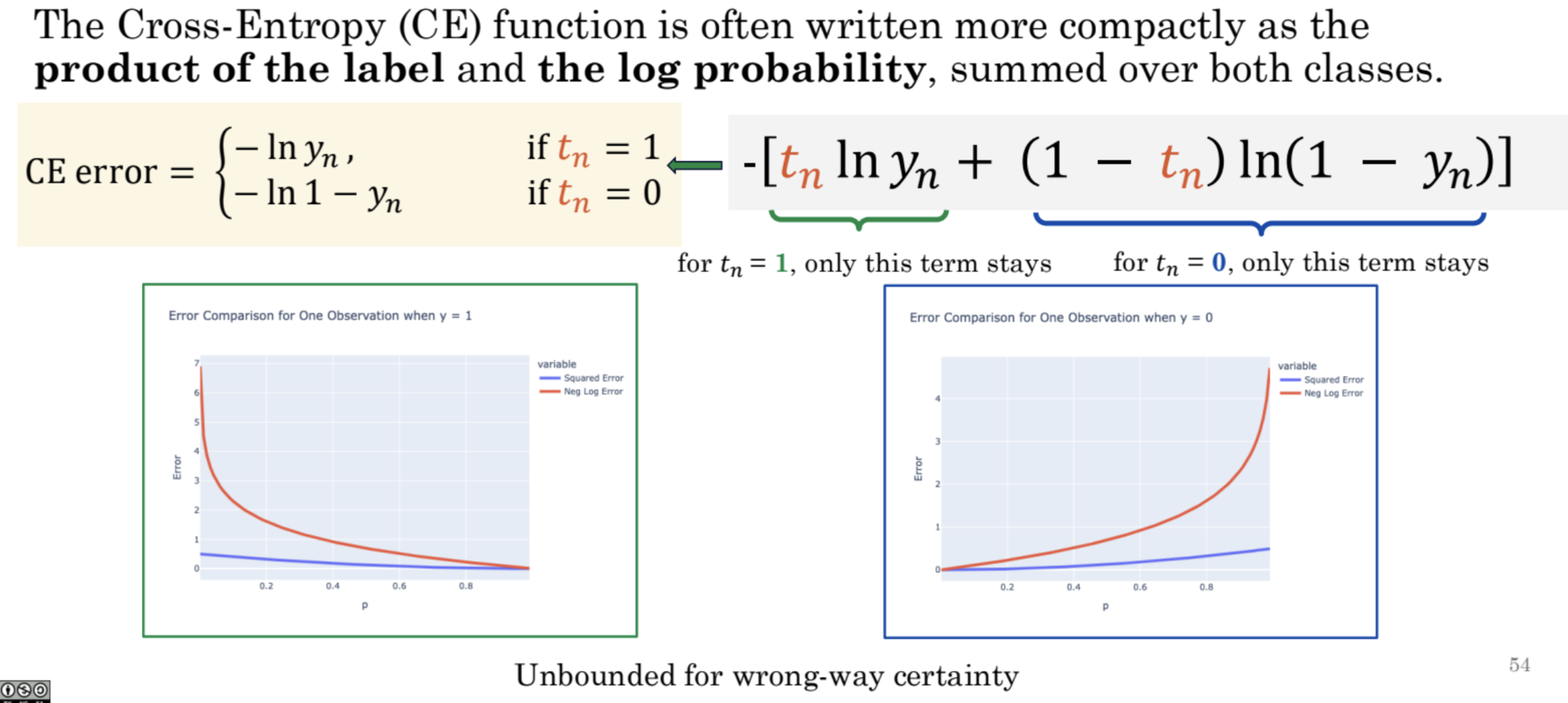
where . We minimize the negative log-likelihood, also known as the cross-entropy loss. Note here since the points are independent, the joint likelihood is just a product of the individual probabilities:
This loss is convex, ensuring a unique global minimum. Unlike linear regression, there is no closed-form solution for logistic regression, because depends nonlinearly on .
Derivation
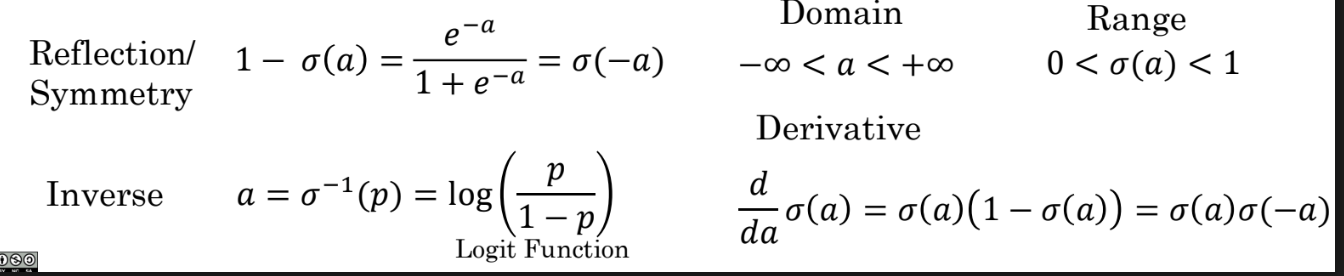
To reason about logistic regression, we need to think in terms of probabilities. Take in the following sentence: logistic regression models the log-odds of class versus as a linear model. Essentially, we have
which when solved yields the sigmoid function , and looks like this: