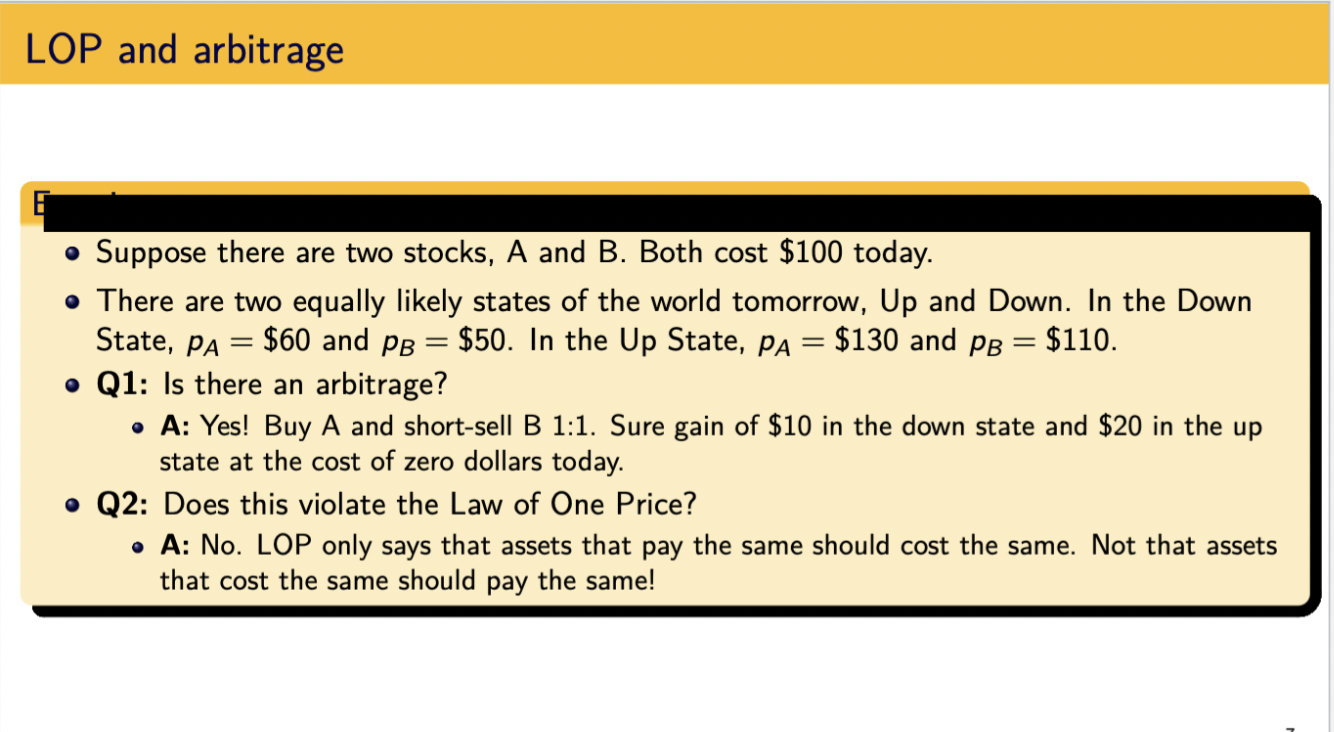
Arbitrage
Arbitrage is the practice of exploiting instantaneous mispricings for the same asset across different markets to secure a low-risk profit.
Arbitrage is precluded by the Law of One Price (LOOP), which states that assets with identical payoffs in the next period should trade at the same price during the current period across all locations or forms. A violation of LOOP becomes the source of arbitrage opportunities.
Theory distinguishes two types of arbitrage, which differ in how quickly the payoff is realized:
- Type 1 Arbitrage involves two traded positions that deliver the same payoff in every state of the world over the same horizon, so any price difference is a pure LOOP violation that can be locked in for an almost immediate profit.
- Type 2 Arbitrage involves a long position in the relatively undervalued asset and a short position in the relatively overvalued asset, with profits realized only if prices converge over time, which introduces interim risk and frictions like funding constraints, shorting costs, and illiquidity. It is also known as a convergence trade.
- In theory, convergence trades eliminate fundamental risk, but are susceptible to behavioral risk that moves prices in the opposite direction of the predicted LOOP price.
Examples