Stability in Discrete-Time LTI Difference Equation Model w/ No Input
For an input-lessdiscrete-time LTI modelx[i+1]=Ax[i] with x[0]=x0, where A∈Rn×n has eigenvalues λ1,...,λn, the model is:
Internally stable, if ∣λi∣ < 1 for all i.
Marginally stable, if
The absolute largest value among all eigenvalues is exactly 1.
Any eigenvalue that has a magnitude of 1 is unique.
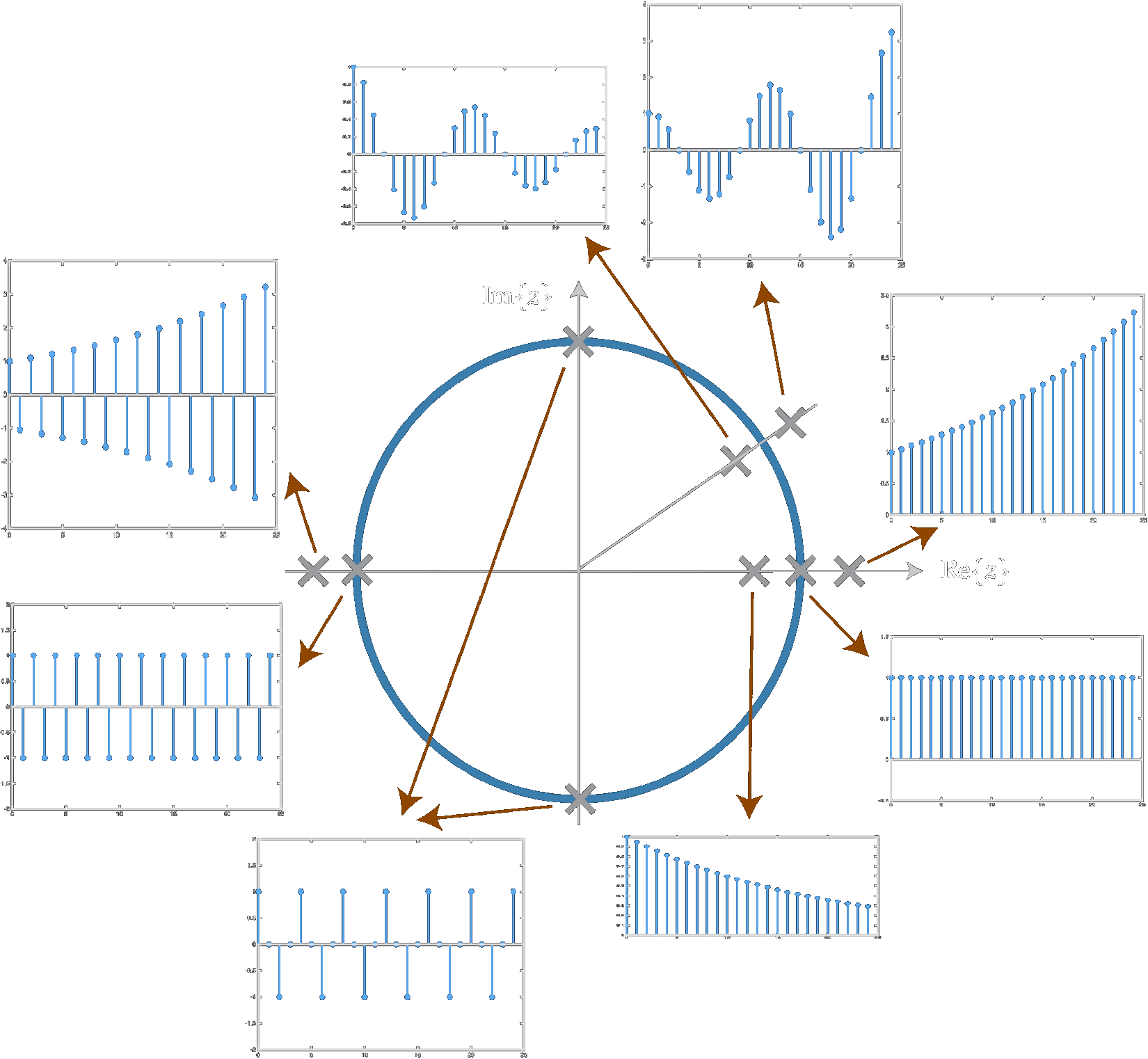
Discrete-time stability can be illustrated on the Cartesian plane as
\usepackage{tikz}\usepackage{pgfplots}\begin{document}\begin{tikzpicture} % draw the coordinates \draw[->] (-2.5, 0) -- (2.5, 0) node[right] {$Re\{\lambda\}$}; \draw[->] (0,-2.5) -- (0,2.5) node[above] {$Im\{\lambda\}$}; \pgfsetfillopacity{0.25} % draw the unit circle \draw[thick, color=yellow, fill=red!30] (0, 0) circle(1.5);\end{tikzpicture}\end{document}
Where the light-red-filled area of the circle (∣λ∣<1) is where internal stability is guaranteed, and the circle’s yellow perimeter (∣λ∣=1) is where marginal stability may occur. Non-colored areas (∣λ∣>1) indicate where internal stability is guaranteed not to occur.
Intuition
We can exemplify all of the possibilities of discrete-time stability below:
Example
Scalar Case
In the scalar case, the solution to the input-lessx[i+1]=x[i] is x[i]=aix0+∑k=0i−1Ai−k−1bu[k].